In a Greek taverna you order for the table, not for yourself. Start with several meze and a salad to share, then add one or two mains or a whole fish to split. Fish is priced per kilo, so ask the weight and total before it is cooked. House wine is ordered by weight, usually half a kilo or a kilo. Expect a small bread charge, and ask for the bill when you are ready.
That is the whole system in one paragraph, but the details are what separate a good taverna meal from an expensive, confusing one. With the season over and most Skiathos tavernas closed until spring, late November is a good time to learn the rules before a 2027 trip - so that on your first evening back on the island, you order like someone who has been coming for years.
Key Takeaways
- Greek taverna meals are shared: order meze and salads for the middle of the table, then mains to split.
- Dishes arrive as they are ready, not in fixed courses; start eating as soon as plates land.
- Fresh fish is priced per kilo of raw weight - choose, confirm the weight and total, then let it be grilled.
- House wine is sold by weight: half a kilo (about 500 ml) for two is a sensible start.
- A bread and cover charge of roughly 0.50-2 EUR per person is common and is not a tip.
- The Sporades speciality to look for is the fried spiral cheese pie, served with honey and thyme.
How Does Ordering in a Greek Taverna Work?
Order everything for the table at once, centred on shared plates. Bread and drinks come first, then meze and salads arrive as they are ready, followed by mains. Nobody will rush you, and the bill only comes when you ask for it.
The rhythm surprises visitors used to starters, mains and dessert. In a taverna the table fills up gradually. Tzatziki might arrive with the bread, grilled octopus ten minutes later, the salad somewhere in between. As the Meze article on Wikipedia explains, small shared dishes are the backbone of eating out across Greece and the eastern Mediterranean, and the meal is built around them rather than around individual mains.
A practical structure for two to four people:
- Drinks and bread: order wine, beer or tsipouro straight away.
- Three or four meze: a dip, something fried, something vegetable, something from the sea.
- One salad: a horiatiki (village salad) feeds two to three as a side.
- One or two mains or a fish: to share, not one each.
- Pause: see how hungry you are before ordering more. Adding dishes later is completely normal.
The most common mistake is over-ordering. Greek portions are generous, and four people ordering four mains plus meze will leave half of it. Order less than you think, then add.
Ask what is good today
Many tavernas have dishes that are not on the printed menu, or are off it that day. Asking "ti protínete?" - what do you recommend? - is not naive, it is how locals order. Our Greek phrases for travellers guide has the pronunciation and the other taverna phrases worth knowing.
Which Meze Should You Order?
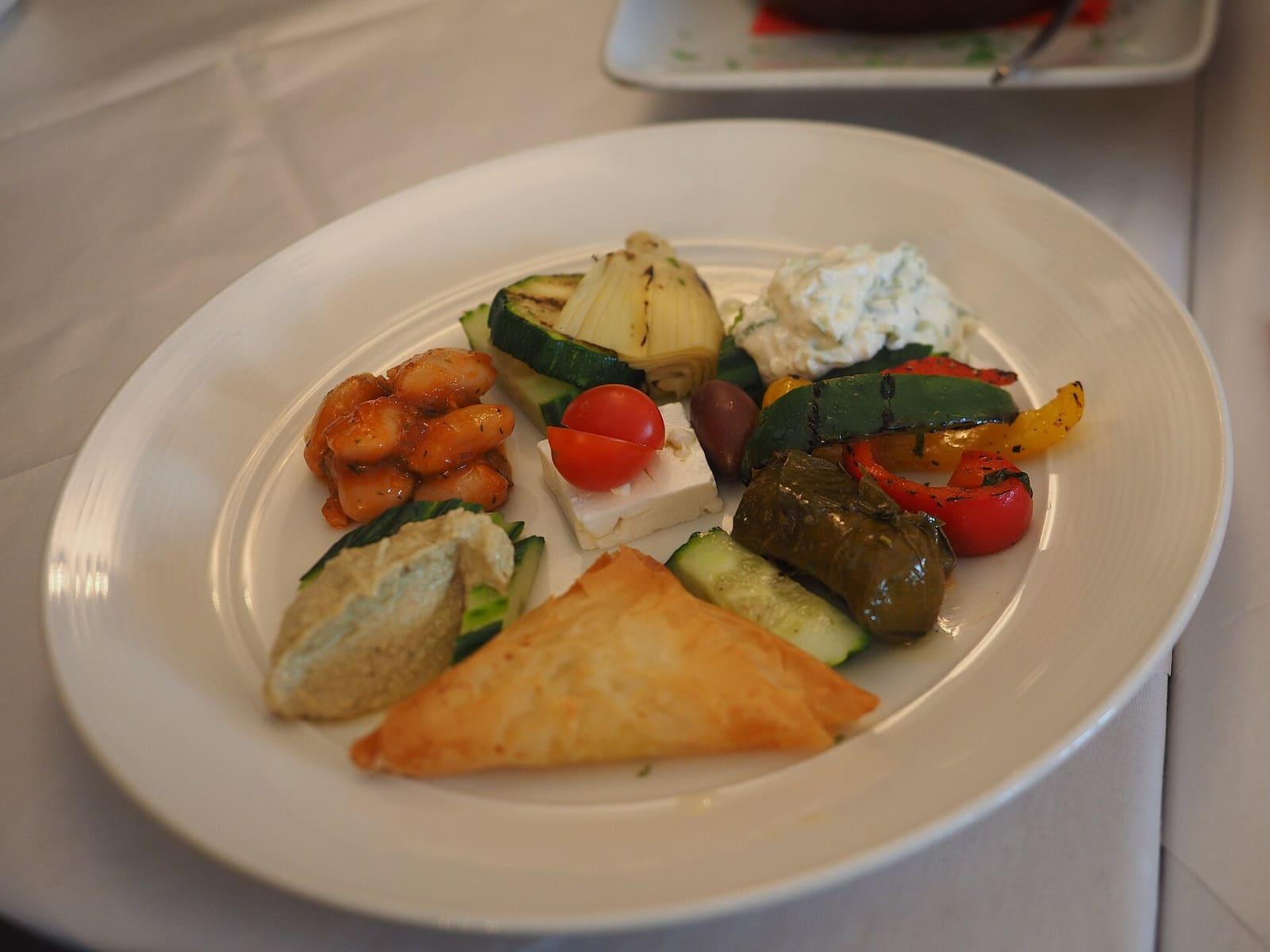
Choose a mix: one dip, one fried dish, one vegetable or pulse dish and one seafood plate. Tzatziki, fava, saganaki, horta and grilled octopus are reliable choices in almost any island taverna.
| Meze | What it is | Why order it |
|---|---|---|
| Tzatziki | Yoghurt, cucumber and garlic dip | The classic with bread and grilled meat |
| Melitzanosalata | Smoky aubergine dip | Lighter than tzatziki, great with bread |
| Taramosalata | Fish roe dip | The real thing is pale, not bright pink |
| Fava | Yellow split pea purée with onion and oil | Silky, filling, very Greek |
| Saganaki | Pan-fried cheese | Hot, salty, best eaten immediately |
| Kolokithokeftedes | Courgette fritters | A favourite with children and vegetarians |
| Keftedes | Fried meatballs with herbs | Simple and dependable |
| Horta | Boiled wild or cultivated greens with lemon and oil | The dish locals order most |
| Gigantes | Giant beans baked in tomato | Hearty; often vegetarian |
| Dolmadakia | Vine leaves stuffed with rice and herbs | Good cold on a hot evening |
| Kalamarakia | Fried squid | Ask whether it is fresh or frozen |
| Chtapodi | Grilled octopus | The island essential with ouzo |
One local signal worth knowing: menus in Greece usually mark frozen ingredients, often with an asterisk next to the dish. Frozen squid or prawns are not necessarily bad, but if you want the fresh catch, ask.
What Mains Should You Order, and How Does Fish by the Kilo Work?
Mains split into mageirefta (dishes cooked earlier in trays, such as moussaka and gemista) and tis oras (cooked to order, mainly grills). Fish is chosen whole, weighed raw and priced per kilo - always confirm the weight and total before it is cooked.
Mageirefta: the ready-cooked dishes
These are the dishes slow-cooked in the morning and served through the day: moussaka, pastitsio (baked pasta with meat sauce), gemista (stuffed tomatoes and peppers), stifado (beef or rabbit stew with small onions), briam (roast vegetables) and kokkinisto (meat braised in tomato). They are best at lunch or early dinner. By 22:30 in high season the trays can be nearly empty.
Tis oras: cooked to order
Grilled meats are cooked when you order them. Souvlaki (skewers), paidakia (lamb chops), biftekia (Greek burgers) and loukaniko (sausage) are staples. Pork and chicken are usually the best value; lamb chops are priced higher and sometimes by the kilo.
Fish by the kilo
Fresh fish is the most misunderstood part of the menu. The price is listed per kilo of raw weight, and a whole fish for two often weighs somewhere around 600 g to 1 kg. The process should be:
- Ask to see the fish. Good tavernas keep the day's catch on ice.
- Choose one, or ask for advice on what is freshest.
- Ask for the weight and the total price before it is cooked.
- Decide how you want it - grilled with oil and lemon is the default.
| Fish (Greek name) | English | Typical style | Notes |
|---|---|---|---|
| Tsipoura | Gilt-head bream | Grilled whole | Often farmed; ask if you want wild |
| Lavraki | Sea bass | Grilled whole | Also commonly farmed |
| Barbounia | Red mullet | Fried or grilled | Prized, priced accordingly |
| Marides | Picarel / whitebait | Fried whole | Cheap, crunchy, eaten head and all |
| Sardeles | Sardines | Grilled | Inexpensive and excellent |
| Fagri, synagrida | Sea bream varieties | Grilled | Premium, can be expensive by the kilo |
Smaller fish such as marides and sardines are the best value on any Greek menu. Large prized fish can push the bill up quickly, which is why confirming the total matters. Prices vary with the catch and the season, so we do not quote figures here.
How Do House Wine, Bread and the Bill Work?
House wine (hima) is sold by weight - half a kilo is about 500 ml. Bread usually carries a small per-person charge. Ouzo and tsipouro come with meze. The bill arrives only when requested, and a small cash tip is customary.
House wine by the kilo
The phrase you will use most is "misó kiló lefkó" or "misó kiló kókkino" - half a kilo of white or red. It arrives in a metal jug or glass carafe and is usually the cheapest wine on the list. As Athens Insiders notes, it is worth asking what the house wine actually is, because at a good taverna the owner has strong opinions about it. On Skiathos, many tavernas also stock bottles from Parissis, the island's own winery - our Parissis winery guide explains the range.
Ouzo and tsipouro
Ouzo and tsipouro are drunk with food, not before or after it. They are often served in small bottles with ice and water; adding water turns ouzo cloudy. Order one with grilled octopus or fried fish and you are eating exactly as locals do.
Bread and cover charge
Many Greek tavernas add a small charge for bread, sometimes covering water and the table setting, of roughly 0.50-2 EUR per person. It appears on the bill and is standard practice, not a tip. If you do not want bread, say so when it arrives.
Fruit, dessert and the bill
At the end of a meal, many tavernas bring something on the house: watermelon in summer, a slice of cake, a spoon sweet or a small glass of liqueur. It is a gesture of hospitality, not a sales tactic. Then ask for the bill - "ton logariasmó, parakaló" - because it will not appear on its own. Greeks usually settle one total rather than splitting by dish. For tipping norms and when to pay in cash, see our money and tipping guide.
What Sporades Specialities Should You Look For on Skiathos?
The signature dish of the Sporades is the spiral cheese pie, fried in olive oil and served with honey and thyme. On Skiathos also look for hortopita, local fish, hamalia walnut pastries and the white almond spoon sweet aspro.
Visit Greece describes the Skopelos cheese pie as a simple dough wrapped around crumbled feta or myzithra, seasoned with oregano and pepper, coiled into a spiral and fried until golden. It is served warm with honey and thyme or with yoghurt. It is salty, sweet and crisp at once, and far removed from the baked filo triangles sold across the rest of Greece.
Skiathos has its own version. The Greek Gastronomy Guide notes that across the Sporades the spiral pie is sometimes fried and sometimes baked, occasionally made with greens instead of cheese, and that its true origin is debated - some trace it to Alonissos. Whichever island claims it, order it when you see it.
Other Skiathos specialities, several of which our best restaurants in Skiathos guide covers in more depth:
- Hortopita: pie made with wild greens and herbs, tasting quite different from spinach pie.
- Local fish: whatever the island boats landed that morning, simply grilled.
- Hamalia: fried pastries filled with walnuts and finished with honey.
- Aspro: a white spoon sweet of almonds, syrup and lemon.
- Tsipouro: the clear grape spirit of central Greece, served cold with meze.
If you are planning a day trip, Skopelos itself, a short ferry ride away, is the natural place to try the original - our Skopelos day trip guide covers the summer crossings.
Taverna culture also travels well indoors. Our guests often book the optional private chef service at Damari for a meze evening on the terrace, or fire up the BBQ with fish bought that morning in Skiathos Town. Both villas have fully equipped kitchens and outdoor dining areas, and Villa Moondancer, at the highest point of the retreat, turns a home-cooked spread of horta, grilled fish and house wine into a sunset dinner. Our amenities page lists what is in each kitchen.
Frequently Asked Questions
How do you order in a Greek taverna?
Order for the table, not the individual. Start with three or four meze and a salad to share, add bread, then choose one or two mains or a fish to split. Dishes arrive as they are ready rather than in strict courses. Order wine or tsipouro at the start, and ask for the bill when you are ready to leave.
Why is fish priced per kilo in Greece?
Fresh whole fish varies in size, so tavernas price it by the kilo of raw weight. You choose a fish from the display, it is weighed and then cooked. Always ask for the weight and the total price before it goes on the grill, and remember that small fish such as marides are far cheaper.
Do Greek tavernas charge for bread?
Many do. A cover charge for bread, and sometimes water and the table setting, of roughly 0.50-2 EUR per person is common and appears on the bill. It is a standard charge rather than a scam and is not a tip for the waiter.
What is the difference between mageirefta and tis oras?
Mageirefta are dishes cooked in advance in trays or pots, such as moussaka, pastitsio, gemista and stifado, and are best at lunch or early dinner. Tis oras means cooked to order, usually grilled meat such as souvlaki, lamb chops and biftekia, or fried dishes.
What should I order in a taverna on Skiathos?
Try a fried spiral cheese pie, the Sporades speciality, served with honey and thyme. Add hortopita (wild greens pie), grilled octopus, fresh fish from the day's catch, horta (boiled greens) and a carafe of house wine or tsipouro. Finish with whatever sweet or fruit the house offers.
Is it rude to split the bill in Greece?
It is not rude, but it is uncommon among Greeks, who usually let one person pay or divide the total evenly. Tavernas will generally split a bill for visitors if asked, though it is easier to settle one total and sort it out among yourselves. Leaving a small tip in cash is customary.
Know the words before you sit down: Our Greek phrases for travellers guide covers ordering, toasting and asking for the bill.
Take the flavours home: The Skiathos shopping and local products guide explains where to buy pine honey, olive oil and Parissis wine.
Where to eat: Our best restaurants in Skiathos guide names the tavernas worth booking.
At Damari Luxury Villas, some of the best Greek meals our guests remember are the ones eaten at home - meze on the terrace, fish on the BBQ, a jug of house wine as the light goes. Our two private villas in the Kechria area sit among pine forest and olive groves, each with a private infinity pool, fully equipped kitchen, and outdoor dining areas, with an optional private chef for nights you would rather not cook. It is the ideal base for a food-led summer 2027 on Skiathos. Explore our villas or contact us to start planning.
Frequently asked questions
How do you order in a Greek taverna?
Order for the table, not the individual. Start with three or four meze and a salad to share, add bread, then choose one or two mains or a fish to split. Dishes arrive as they are ready rather than in strict courses. Order wine or tsipouro at the start, and ask for the bill when you are ready to leave.
Why is fish priced per kilo in Greece?
Fresh whole fish varies in size, so tavernas price it by the kilo of raw weight. You choose a fish from the display, it is weighed and then cooked. Always ask for the weight and the total price before it goes on the grill, and remember that small fish such as marides are far cheaper.
Do Greek tavernas charge for bread?
Many do. A cover charge for bread, and sometimes water and the table setting, of roughly 0.50-2 EUR per person is common and appears on the bill. It is a standard charge rather than a scam and is not a tip for the waiter.
What is the difference between mageirefta and tis oras?
Mageirefta are dishes cooked in advance in trays or pots, such as moussaka, pastitsio, gemista and stifado, and are best at lunch or early dinner. Tis oras means cooked to order, usually grilled meat such as souvlaki, lamb chops and biftekia, or fried dishes.
What should I order in a taverna on Skiathos?
Try a fried spiral cheese pie, the Sporades speciality, served with honey and thyme. Add hortopita (wild greens pie), grilled octopus, fresh fish from the day's catch, horta (boiled greens) and a carafe of house wine or tsipouro. Finish with whatever sweet or fruit the house offers.
Is it rude to split the bill in Greece?
It is not rude, but it is uncommon among Greeks, who usually let one person pay or divide the total evenly. Tavernas will generally split a bill for visitors if asked, though it is easier to settle one total and sort it out among yourselves. Leaving a small tip in cash is customary.
Sources & last checked
- Visit Greece - Skopelos cheese pie (Official description of the fried spiral cheese pie and how it is served)
- Greek Gastronomy Guide - The cheese pie of the Sporades (Skiathos and Sporades variations of the spiral cheese pie)
- Meze (Wikipedia) (Background on the meze tradition across Greece and the eastern Mediterranean)
- Athens Insiders - Greek tavernas, how to order like a local (Local perspective on house wine and ordering customs)