Skiathos has two significant monasteries that are straightforward to visit, a medieval hilltop settlement with surviving churches, a museum dedicated to one of Greece's most important authors, and an Orthodox Easter that draws visitors specifically for its rituals. The most historically notable site is Moni Evangelistrias, an 18th-century monastery where Greek revolutionaries gathered in 1807 and, according to multiple historical sources, swore the oath of freedom on a newly made Greek flag - fourteen years before the War of Independence formally began.
Key Takeaways
- Moni Evangelistrias was founded in 1794 by Kollyvades monks from Mount Athos; construction was completed in 1806.
- In September 1807, revolutionary leaders including Theodoros Kolokotronis and Andreas Miaoulis reportedly gathered here and swore an oath on a new Greek flag - one of the earliest organised acts of the independence movement.
- The monastery museum (€2 entry) displays the loom on which the flag is said to have been woven, plus ecclesiastical artefacts, manuscripts, and rare books.
- Monks still produce Alypiakos, a red Muscat wine, on the monastery's vineyards; bottles are sold in the on-site shop.
- Panagia Kounistra (also called Panagia Eikonistria) dates to 1655, sits 13 km from Skiathos Town, and holds the island's patron icon.
- Kastro, the medieval clifftop settlement, had more than 20 churches at its peak; two survive intact and contain frescoes.
- Orthodox Easter in Skiathos follows the Mount Athos ritual and includes a night procession beginning at 01:00, unusually early even by Greek standards.
What Is the Most Significant Monastery in Skiathos?
Moni Evangelistrias is Skiathos's most historically important monastery, founded in 1794 and connected to the origins of the Greek Revolution through a documented gathering of freedom fighters in 1807.
The monastery sits in the pine-forested hills about 5 km from Skiathos Town. To reach it, take the road toward Kastro and follow the clearly signed right-hand turn. The road is paved, parking is available, and the drive takes around 10 minutes from town.
It was founded by a group of Kollyvades monks - a reformist movement that had left Mount Athos following disagreements over Orthodox ritual - led by a monk named Niphon of Chios. A local monk, Gregorios Hatzistamatis, contributed family land to the project. Construction ran from 1794 to completion in 1806.
The monastery's historical significance rests on what happened the following year. In September 1807, according to Wikipedia's entry on Evangelistria Monastery and local historical records, a group of Greek revolutionary figures gathered here and swore the Oath of Freedom. Those present included Theodoros Kolokotronis and Andreas Miaoulis - men who would become leading military figures in the War of Independence that began in 1821. The flag on which the oath was sworn - a white cross on a sky-blue background - was woven at the monastery's loom.
It is worth being precise: sources describe this as one of the earliest organised acts of the pre-revolutionary movement, not as the moment the Greek flag was "first raised" in a state sense. The 1807 gathering was a private oath, not a formal declaration, but its symbolic weight is real and the monastery treats this history seriously.
The Museum and What to See
A museum inside the monastery charges €2 for admission. It contains:
- The loom on which the flag is said to have been woven
- Ecclesiastical artefacts and silver crosses
- Rare books, manuscripts, and documents from the pre-revolutionary period
- Icons and items related to the monastery's role in the independence movement
The monastery church, courtyard, and gardens are part of the same visit. Monks still live and work here. There is a small café and a shop selling honey, olive oil, and the monastery's own wine.
The Monastery's Wine
The vineyards produce Alypiakos, a red Muscat wine named after Father Alypos, the fourth abbot. According to Greeka's guide to the monastery, the Alypiakos variety has roots on Skiathos dating back to antiquity. Bottles are sold in the monastery shop; it is a legitimate reason to visit even for travellers who have little interest in religious history.
What Is Panagia Kounistra Monastery?
Panagia Kounistra (also called Panagia Eikonistria) is a 17th-century monastery built around a miraculous icon said to have been found swinging from a pine tree in 1650. It is considered the spiritual protector of Skiathos.
The monastery sits about 13 km from Skiathos Town on the southwestern side of the island, on the road toward Aselinos Beach. The setting is dense pine forest, and the approach is part of the experience.
The founding legend: in 1650, a hermit monk named Symeon reportedly found an icon of the Virgin Mary suspended from a pine tree, shining with light. The monastery was built on that spot, and its name - Kounistra - derives from the Greek word for swinging. The monastery was formally established in 1655 according to historical records on the site.
The icon itself is not kept at the monastery year-round. It resides in the Three Bishops church in Skiathos Town and is returned to Kounistra each year on 21 November, the feast day of the Presentation of the Virgin Mary - one of the major religious celebrations on the island. If you visit around that date, you will encounter the island in full festival mode.
The monastery interior contains a carved wooden iconostasis, frescoes, and icons dating from the 18th and 19th centuries.
Monasteries at a Glance
| Monastery | Founded | Distance from Town | Key Feature | Best Time to Visit |
|---|---|---|---|---|
| Moni Evangelistrias | 1794 | ~5 km | Museum, wine shop, 1807 revolutionary oath | Morning, daily in summer |
| Panagia Kounistra | 1655 | ~13 km | Patron icon, pine forest setting | 21 Nov festival, or summer mornings |
What Are the Churches at Kastro?
Kastro, the abandoned medieval settlement at Skiathos's northern tip, held over 20 churches at its peak. Two survive intact today: the Church of Christ's Birth (Gennisi tou Christou) and Agios Nikolaos, both containing original frescoes.
Kastro functioned as the island's only inhabited settlement from around 1540 to 1829, when the entire population lived behind its walls for protection from pirate raids. The Kastro article on Wikipedia notes that at its height the fortified town had between 500 and 1,500 residents, four parishes, and more than 20 churches. When the castle was abandoned after Greek independence in 1829, the population moved down to found modern Skiathos Town.
The two surviving churches are the primary reason to visit Kastro from a cultural rather than a purely scenic perspective. In recent years, the churches of St. Marina and St. Basil have also been partially restored, along with sections of the Ottoman-era mosque, two cisterns, and the gate complex.
The full guide to visiting Kastro covers the hike (30-40 minutes from the main road through pine forest), the seasonal boat option from Skiathos Town (approximately 45 minutes), and the beach below the cliffs. This post focuses on the ecclesiastical side; the castle itself is covered there in detail.
Who Was Papadiamantis and Why Does He Matter?
Alexandros Papadiamantis (1851–1911) was born in Skiathos and is regarded as one of the most important prose writers in modern Greek literature. His work is inseparable from the island's Orthodox identity - he was a devoted churchgoer and chanter throughout his life.
Papadiamantis's house in Skiathos Town has been preserved as a museum. The Papadiamantis House Museum is a modest stone building in the old part of town - the author lived simply - displaying his personal belongings, manuscripts, and the room where he wrote. Admission is low and the visit is short, but it gives context to the island's self-image as a place of genuine Hellenic culture rather than just tourism.
His fiction, including his best-known work The Murderess (1903), is set almost entirely in Skiathos and draws on Orthodox village life, the landscape, and the moral textures of island society. He is sometimes called the "Saint of Greek Letters," a reflection of both the quality of his writing and the religiosity that ran through it.
For any visitor interested in Greek literature, a stop at the museum followed by a walk through the old town he wrote about is genuinely rewarding.
What Religious Festivals Happen in Skiathos?
Skiathos has a full calendar of Orthodox festivals, from the major Kounistra feast day in November to summer panigiria at local chapels and the island's unusually solemn Orthodox Easter.
Orthodox Easter
Easter in Skiathos is widely described by Greek visitors as one of the more spiritually intense island experiences in the country. According to Visit Greece's dedicated page on Easter in Skiathos, the island observes the Mount Athos ritual throughout Holy Week. The most unusual element is timing: the Epitaphios (Good Friday bier) procession begins at 01:00, and the full circumambulation of the town starts at 04:00 - hours when most of Greece is asleep. The narrow streets of Skiathos Town are lit, residents stand at their windows, and the procession passes below.
If you are considering visiting Skiathos for Easter, book well in advance. Accommodation fills up significantly more than for a standard early-season week.
Summer Panigiria
Throughout July and August, small religious festivals - panigiria - take place at chapels and village squares across the island. These typically involve an evening liturgy, followed by music, dancing, and food. They are informal, open to anyone, and genuinely local rather than staged for tourists. Dates shift slightly year to year based on the Orthodox calendar of saints' days; asking at your accommodation is the best way to find out what is happening nearby.
The Kounistra Feast Day (21 November)
The annual return of the patron icon from Skiathos Town to Panagia Kounistra Monastery on 21 November is a significant event in the island's religious calendar. It is outside peak tourist season, which means it is experienced almost entirely by locals. If you happen to be in Skiathos in late November - possible in a mild year - it is worth attending.
How Do You Visit a Greek Orthodox Monastery Respectfully?
The standard requirement at Greek monasteries is covered shoulders and knees for all visitors. Most monasteries also expect quiet behaviour and ask that photography inside the church is kept to a minimum or avoided entirely.
Practical checklist:
- Women: skirt or trousers covering the knee, top covering the shoulders. Some monasteries require women to wear skirts rather than trousers; Evangelistria is relatively relaxed but it is worth carrying a shawl.
- Men: trousers to the knee, no sleeveless tops.
- Both: remove hats before entering the church. Keep voices low.
- Photography: permitted in the courtyard and gardens at most monasteries; inside the church, ask or follow what others are doing.
- Opening hours: most Skiathos monasteries open from approximately 08:00 to 13:00 and reopen from 17:00 to 20:00. Midday closure is common in summer. Verify locally before making a special trip.
- The museum at Evangelistria may have different hours from the monastery church - the €2 admission desk is the best place to confirm on arrival.
Can You Combine Monastery Visits with Hiking?
Yes. Evangelistria sits along the island's main hiking network and can be combined with a route to Kastro. The trail between the two passes through undisturbed pine forest and takes roughly 2-2.5 hours in total.
Skiathos has a well-marked network of trails through the pine forest interior. The monastery road to Evangelistria connects to trails that continue north toward Kastro, making it possible to visit one in the morning, walk through the forest, and reach the other by midday. Our full hiking guide for Skiathos maps the main routes and gives timing from different starting points.
A practical sequence for a cultural half-day:
- Drive to Evangelistria early (before 10:00 to beat the midday heat and any coach groups). Visit the monastery and museum - allow 45-60 minutes.
- Walk north on the forest trail toward Kastro (approximately 1.5-2 hours on foot). Or drive back and take the Kastro road.
- Spend an hour at the ruins, see the two surviving churches, walk down to the beach below if the heat allows.
- Return via the seasonal boat to Skiathos Town (runs in July-August), or drive back on the paved road.
For Panagia Kounistra, the approach through the forest on the southwestern side of the island is a separate excursion and is best done in the morning. Allow 30 minutes to visit the monastery itself.
What Other Cultural Sites Are Worth Visiting in Skiathos?
Beyond the monasteries and Kastro, Skiathos Town has a handful of sites that reward a slow walk:
- Papadiamantis House Museum - the writer's preserved home in the old quarter. Small, free or minimal admission, open mornings.
- Bourtzi fortress - a small Venetian promontory at the entrance to the old harbour, now used as a cultural venue in summer. Walkable in 5 minutes from the port.
- Skiathos Town's old churches - including the Three Bishops church which houses the Kounistra icon for most of the year.
- The old port area - the narrow lanes behind the waterfront predate the tourist era and contain a mix of working religious buildings and traditional houses.
Our Skiathos Town guide covers the town itself in detail, and our hidden gems post includes several lesser-known chapels and corners that don't appear in standard itineraries.
Frequently Asked Questions
Is the Evangelistria Monastery really where the first Greek flag was made?
Sources including Wikipedia and the monastery's own historical records state that in September 1807, Greek revolutionary figures gathered here and swore an oath on a Greek flag that was woven at the monastery. The flag used a white cross on a sky-blue background. This is described as one of the earliest organised acts of the pre-independence movement - a significant event, though historians are careful to note it was a private revolutionary gathering rather than a formal state act. The physical loom is displayed in the on-site museum.
How far is Evangelistria Monastery from Skiathos Town?
The monastery is approximately 5 km from Skiathos Town, about a 10-minute drive on a paved road. Follow the main road toward Kastro and take the signed right-hand turn. There is on-site parking. A taxi from the port takes around 10-15 minutes.
Do I need to pay to enter the monasteries?
Panagia Kounistra is free to enter. Evangelistria charges €2 for the museum section, which includes access to the ecclesiastical artefacts and the historical loom. The monastery church and courtyard are generally free.
Can I buy the monastery wine at Evangelistria?
Yes. The monastery shop sells bottles of Alypiakos, the red Muscat wine produced on the monastery's own vineyards. Honey and olive oil made locally are also available. The shop is open during normal visiting hours.
When is the best time to visit Skiathos for cultural sites?
June and September are the best months for cultural visits - the sites are open, the heat is manageable for walking between them, and there are fewer day-trippers at Evangelistria and Kastro. The Kounistra feast day on 21 November is the most atmospheric single event, but it is outside the main tourist season.
Is Orthodox Easter worth visiting Skiathos for?
Yes, if you are specifically interested in Orthodox ceremony rather than beach weather. Skiathos Easter follows the Mount Athos ritual and includes a night procession beginning at 01:00 that winds through the old town while residents watch from lit windows. It is a genuine religious and cultural event. Sea temperatures in April are cold for swimming, so the trip is cultural rather than beach-focused.
How do I dress to enter the monasteries?
Covered shoulders and knees are required at both Evangelistria and Kounistra. Women should carry a shawl or wear a skirt or long trousers and a top that covers the shoulders. Men should wear long trousers and avoid sleeveless tops. Both monasteries may provide wraps at the entrance, but bringing your own is more reliable.
Can I combine a monastery visit with a beach day?
Easily. Evangelistria is done in an hour; visit in the morning and you will be on a beach by 11:00. Panagia Kounistra is on the route to Aselinos Beach on the north coast, so a monastery visit can be the natural starting point for that beach day. Kastro, similarly, sits above its own beach - the trail down is steep but swimmable after the culture.
Explore more of Skiathos: The Kastro medieval castle guide covers the fortress ruins, church frescoes, and beach below in full detail. The hiking trails guide maps the routes that connect these cultural sites through the pine forest. For a full picture of what the island offers, Is Skiathos Worth Visiting? gives the honest overview.
Plan your trip: Our Skiathos travel guide covers everything from getting here to getting around.
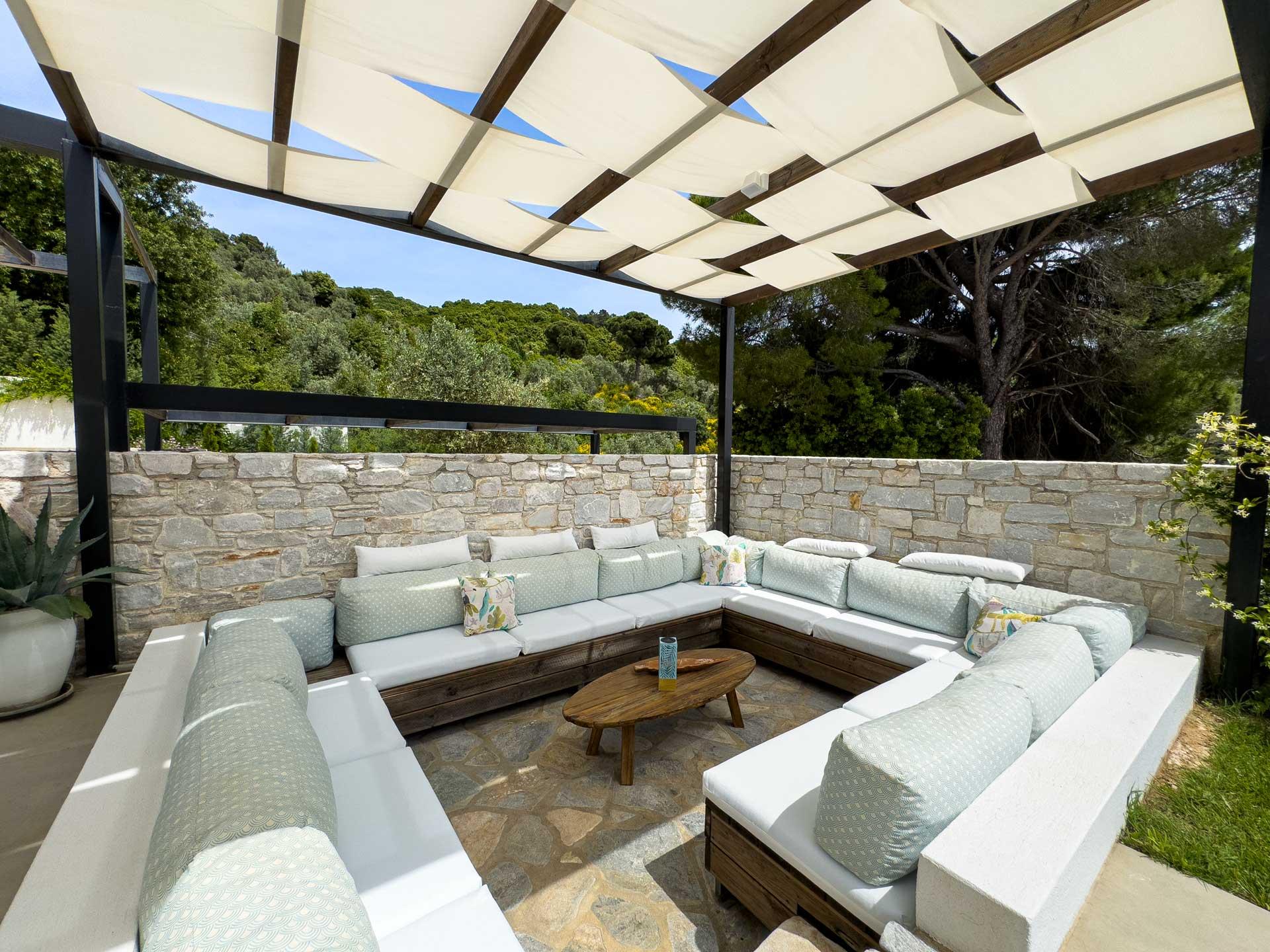
At Damari Luxury Villas, we host guests in the Kechria area - a quiet hillside location 5-7 km from both Evangelistria Monastery and the Kastro trail. After a morning in the churches or the forest, the private pool is a straightforward way to close the day. Our two villas sleep up to six guests each, and our host Tolis is happy to advise on the best times to visit cultural sites. Contact us to plan your stay.