Most articles about accessible Greek islands are written by people who have never pushed a wheelchair over a cobbled lane in 32°C heat. They mention that Greece has accessible beaches now, add a photo of blue water, and stop there. That is not much use when you are trying to decide whether to book flights.
So here is the honest version for Skiathos. It is a workable island with limited mobility, but only if you plan around its geography rather than fighting it. The flat, modern waterfront by the new harbour, a handful of organised south-coast beaches where you can park within metres of the sand, and an airport that sits 10 to 15 minutes from most places you would stay — those are the things that make it possible. The stepped old town, the Plakes hillside, the Kastro footpath and the boat-only beaches are the things that do not. Knowing which is which before you arrive changes the entire trip.
Key Takeaways
- Greece has installed more than 159 free SEATRAC remote-operated sea-access ramps nationwide, but they are concentrated on larger islands — Corfu has nine, Crete seven or more, Syros four. Confirm current availability on Skiathos locally before travelling.
- Skiathos Town splits into two halves: the flat new-harbour waterfront (manageable) and the stepped old town and Plakes (not).
- Koukounaries, Agia Paraskevi and Achladies are the most practical beaches — parking close to the sand, level approaches, sunbed service, toilets.
- Local buses are cheap and frequent but not step-free. Budget for private transfers and taxis instead.
- June and September are the sweet spot: services running, crowds gone, heat manageable.
- Ask accommodation specific, measurable questions — step counts, door widths, single-level layouts — rather than accepting "accessible" as an answer.
What Greece Has Actually Done About Beach Access
The beach access programme is real, well funded and genuinely impressive — but it is not evenly distributed. Greece has rolled out SEATRAC, a solar-powered, remote-operated ramp that carries a user in a fixed seat down a rail from the shore into the sea and back, on more than 159 beaches nationwide. Use is free. The programme was widely reported internationally as one of the more serious national attempts anywhere to make coastlines usable, with Smithsonian Magazine covering the expansion.
The distribution matters more than the headline number. Corfu leads with nine equipped beaches, Crete has seven or more, Syros four. Those are big or well-resourced islands with year-round municipal budgets. Skiathos is small — 12 km by 6 km, with a permanent population in the low thousands — and installations of this kind come and go with funding cycles and seasonal maintenance.
So the honest answer is: do not travel assuming a SEATRAC unit will be waiting at your chosen Skiathos beach. Contact the municipality directly, or ask your accommodation host to check in the weeks before you arrive. A host who lives on the island can walk down and look, which is worth more than any listing page. If a ramp is operating, treat it as a bonus rather than the foundation of your plans.
Skiathos Town: The Flat Half and the Stepped Half
Skiathos Town is two towns in one, and only one of them works with a wheelchair or a walking frame.
The new harbour waterfront — the long paved strip running from the ferry berths past the taxi rank and along the front — is flat, wide and mostly smooth. Cafés and tavernas spill onto it, the ferry and excursion boat quays are level with it, and you can spend an entire evening there without a step. Pavements are patchy in places and scooters park inconsiderately, but as a promenade it functions.
Papadiamantis Street, the main pedestrian spine, is broadly level for its lower stretch and has most of the shops, pharmacies and banks. Beyond it, the picture changes fast. The old town behind the harbour is a lattice of stepped alleys, whitewashed staircases and worn stone — beautiful, and the reason people photograph Skiathos, but functionally off-limits to wheels and hard on unsteady legs. Plakes, the residential quarter climbing the hill towards the west, is steep enough that even confident walkers pause. The medieval Kastro site is reached by a rough 30-plus minute footpath, and Lalaria is boat-access only with a pebble landing.
This is the pattern across Greek islands generally: waterfronts and newer developments are workable, historic cores rarely are, because they were built for donkeys and defensibility. Skiathos is neither better nor worse than average here. Plan your town time for the harbour front in the evening, and let the old town be something you look up at from a taverna table.
The Skiathos Beaches That Genuinely Work
Choose a beach by the distance from its car park to the sand, not by how good the photo looks. On Skiathos that filter narrows 60-plus beaches down to about three or four reliable options, all on the sheltered south coast.
| Beach | Distance from town | Approach | Notes |
|---|---|---|---|
| Achladies | ~4 km | Short, mostly level from parking | Organised, sunbed service, tavernas, calm shallow water |
| Agia Paraskevi | ~8 km | Level, parking close to sand | Wide and long, two beach bars, space even in high season |
| Koukounaries | ~12 km | Boardwalk sections through pine | Fully organised, toilets, food, shade; last stop on the coast road |
| Troulos | ~9 km | Level, small car park | Quieter, fewer facilities, gentle entry |
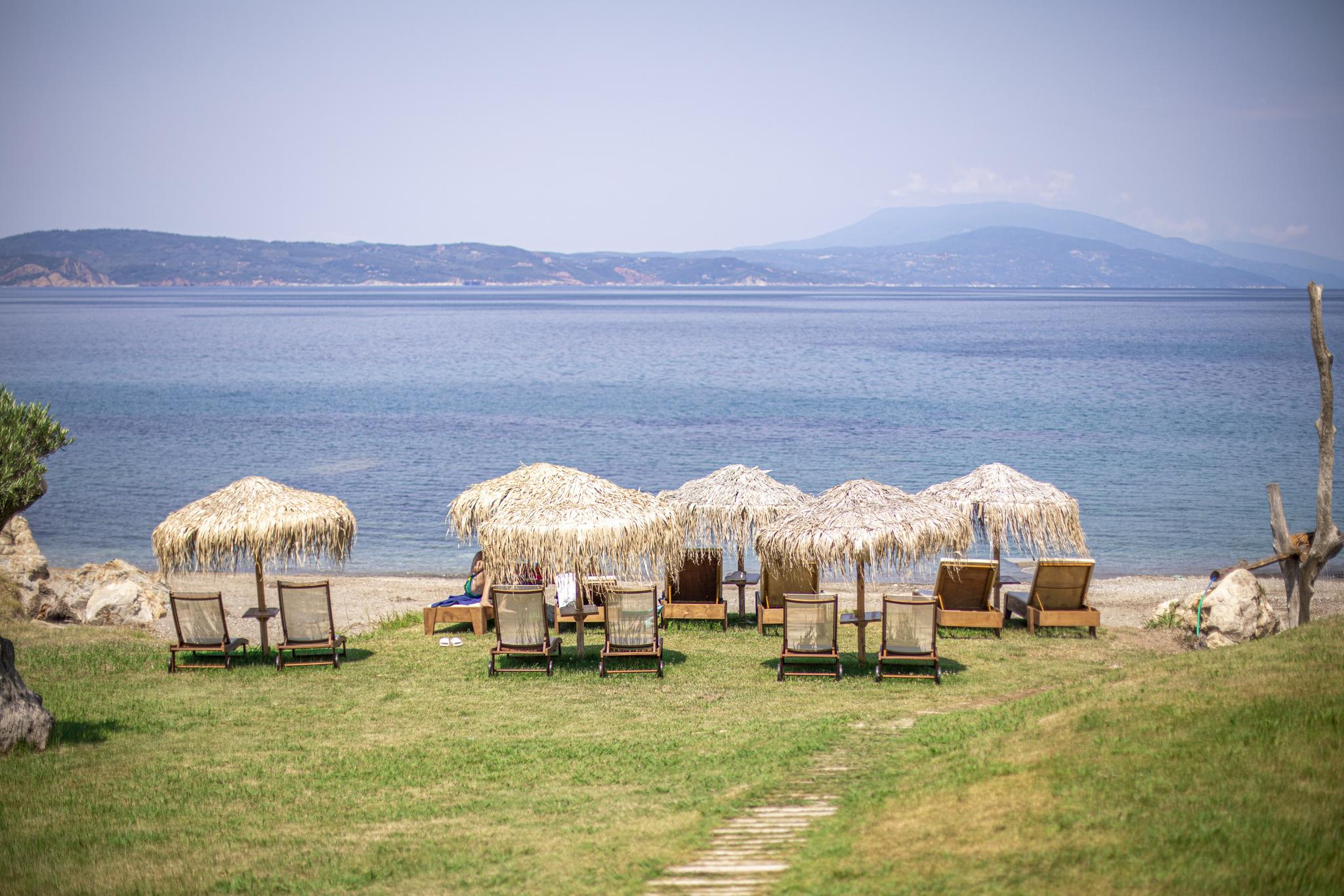
Koukounaries is the one most visitors have in mind, and it is a reasonable choice: sections of boardwalk run through the pine fringe, the beach is fully serviced with sunbeds and umbrellas so you never need to carry a load across sand, and there are toilets and food on site. Agia Paraskevi has the advantage of size — the sand is wide enough that a busy day still leaves room to manoeuvre near the front rows. Achladies is the shortest drive and has the shallowest, calmest entry, which matters if you want to get into the water with assistance.
The mechanics of the day are what to think about. Soft dry sand defeats most wheelchairs; beach wheels or a lightweight beach chair, brought with you, transform the situation. Ask the sunbed operator for a front-row bed close to the walkway and pay the few extra euros without arguing — it saves the hardest 20 metres. Our full Skiathos beaches guide covers what each beach is like, and the beaches without a car guide is useful for understanding the layout even if you will be using taxis rather than buses.
What to skip: Mandraki, Krifi Ammos and the Aselinos coves involve unmade tracks and walks through forest. Lalaria involves a boat, a swim-step and a pebble bank. They are wonderful and they are not for this trip.
Getting Around: Transfers, Taxis and Why Not the Bus
The island bus is excellent value and almost certainly not for you. The south-coast route runs every 10 to 15 minutes in summer for €2-3, but the vehicles have steps at the door, many stops are unpaved laybys with no dropped kerb, and there is no dependable ramp or wheelchair securement. In August they also fill to standing. Our getting around Skiathos guide covers the network properly if you want the detail.
What works instead:
- Pre-booked private transfers. Arrange the airport pickup in advance and specify exactly what you need — space for a folded chair, a vehicle without a high step, extra time. Skiathos airport sits close to town and most south-coast bases are 10 to 15 minutes away, so transfers are short.
- Taxis. The rank at the new harbour is the reliable place to find them; there are relatively few on the island, so book ahead for evening returns rather than hoping. Standard saloons dominate — a genuinely adapted vehicle should be requested well in advance and confirmed.
- A hire car with a driver in the group. On an island this small, parking is the limiting factor, not distance. Beach car parks fill by 11:00 in July and August, which is another argument for June or September.
The flight and airport side is straightforward: Skiathos airport is small, single-terminal and mostly level, though assistance provision is basic compared with a major hub. Book special assistance with your airline at least 48 hours ahead and reconfirm.
Timing, Heat and the Case for June or September
Shoulder season is not just quieter — it is materially easier. In June and September the beaches are fully serviced, lifeguards and seasonal equipment are in place, and sea temperatures sit in the mid-20s°C. What disappears is the August crush: the queue for the beach car park, the packed taverna terrace with no room to turn, the transfer driver who cannot get to the door.
Heat matters too. Skiathos regularly reaches the mid-30s°C in late July and August, and if you tire easily, use a wheelchair, or take medication affected by heat, that changes what a day looks like. September typically holds warm sea with more forgiving air temperatures, and October remains swimmable in the first half of the month. Many of the same arguments apply to older travellers — our Skiathos for over-60s guide goes further into pacing a slower trip.
One practical note: pharmacies in Skiathos Town are well stocked and pharmacists usually speak good English, and there is a health centre on the island for routine issues. Anything more serious involves a transfer to Volos or Athens, so travel insurance that covers medical repatriation is not optional.
Choosing Accommodation: The Questions That Actually Matter
"Accessible" means nothing on a listing page. Numbers do. Before booking anywhere on Skiathos — or any Greek island — ask these:
- How many steps from the parking area or drop-off to the front door, and is there a handrail?
- Are bedroom, bathroom and living space all on one level?
- What is the clear width of the narrowest doorway, in centimetres?
- Is the shower step-in, or does it have a lip or tray? Is there room for a shower chair?
- How is the pool terrace reached — level, ramped or stepped?
- What is the surface of the driveway and outdoor areas: paving, gravel or compacted earth?
Ask for photographs of those specific points rather than the marketing gallery. A picture of a threshold tells you more than twenty pictures of a sunset.
Villas often suit this kind of trip better than hotels, for reasons that have nothing to do with luxury: you control the kitchen and meal timing, there is no lobby-to-lift-to-corridor journey, and the outdoor space is yours, so a swim does not depend on getting to a beach at all. Our two villas sit on the Kechria hillside among pine forest and olive groves, each with a private infinity pool, fully equipped kitchen and outdoor dining, roughly 15 minutes from town and the airport. Because access needs are specific and honest answers matter more than reassuring ones, we would rather you contact us with your exact requirements and let us describe the steps, levels and surfaces at Villa Moondancer and Villa Whispering Pines precisely, than make promises on a page. The gallery will give you a first look, and we will send whatever additional photographs you need.
Frequently Asked Questions
Is Skiathos wheelchair accessible?
Partly. The new-harbour waterfront in Skiathos Town is flat and paved, several south-coast beaches have level boardwalks and parking within metres of the sand, and the airport is small and close to most accommodation. But the old town is built on steps and cobbles, the Plakes district climbs steeply, and Kastro and Lalaria are reached only on foot or by boat. Plan around the flat parts rather than expecting full island access.
Does Skiathos have SEATRAC beach access ramps?
Greece has installed more than 159 free SEATRAC remote-operated sea-access ramps nationwide, with Corfu leading at nine beaches, Crete at seven or more and Syros at four. Skiathos is a much smaller island and installations change season by season, so contact the municipality or ask your accommodation to confirm current SEATRAC availability before you travel rather than assuming it.
Which Skiathos beaches are easiest with limited mobility?
The organised south-coast beaches are the practical choices: Koukounaries, Agia Paraskevi and Achladies. All three have car parking close to the sand, level or gently graded approaches, sunbed service so you do not need to carry anything, and toilets and tavernas on site. Achladies is the shortest drive from town at around 4 km.
Are Skiathos buses accessible for wheelchair users?
Generally no. The south-coast bus is frequent and cheap at €2-3, but the vehicles typically have steps at the door, stops are often unpaved laybys, and there is no reliable ramp or securement space. Most visitors with limited mobility use pre-booked private transfers or taxis instead, which on an island this small are short and reasonably priced.
When is the best time to visit Skiathos with limited mobility?
June or September. Beach services, lifeguards and any seasonal access equipment are fully in place, sea temperatures are warm, and the crowds that make parking, boardwalks and taverna terraces hard to navigate in August have thinned out. Peak-season heat also matters if you tire easily or use a wheelchair.
Are Greek islands good destinations for travellers with disabilities?
It varies enormously. Greece has invested heavily in beach access, but many islands remain hard going because of uneven terrain, stepped lanes and older architecture that predates any accessibility standard. Larger islands such as Corfu and Crete generally offer more adapted infrastructure than small ones. Research each island specifically rather than treating Greece as a single answer.
What should I ask a villa about accessibility before booking?
Ask for the number of steps from the parking area to the front door, whether bedrooms and bathrooms are on a single level, doorway widths, whether the shower is step-in or has a lip, and how the pool terrace is reached. Photographs rarely show thresholds or level changes, so ask directly and ask for pictures of the specific approach you would use.
Travelling at a slower pace: Our Skiathos for over-60s guide covers pacing, heat and quieter months.
Getting around the island: Read getting around Skiathos for the full picture on buses, taxis and car hire.
Choosing your beach: The Skiathos beaches guide sorts 60-plus shores by what you actually want from a day.
At Damari Luxury Villas, we would rather give you an accurate answer about steps and surfaces than an optimistic one. Our two private villas in the Kechria area sit among pine forest and olive groves, each with a private infinity pool, fully equipped kitchen, and BBQ and outdoor dining — so a swim, a meal and an evening outside never depend on navigating a crowded town. Explore our villas or contact us to tell us exactly what you need and let us describe each villa's access honestly before you book.
Frequently asked questions
Is Skiathos wheelchair accessible?
Partly. The new-harbour waterfront in Skiathos Town is flat and paved, several south-coast beaches have level boardwalks and parking within metres of the sand, and the airport is small and close to most accommodation. But the old town is built on steps and cobbles, the Plakes district climbs steeply, and Kastro and Lalaria are reached only on foot or by boat. Plan around the flat parts rather than expecting full island access.
Does Skiathos have SEATRAC beach access ramps?
Greece has installed more than 159 free SEATRAC remote-operated sea-access ramps nationwide, with Corfu leading at nine beaches, Crete at seven or more and Syros at four. Skiathos is a much smaller island and installations change season by season, so contact the municipality or ask your accommodation to confirm current SEATRAC availability before you travel rather than assuming it.
Which Skiathos beaches are easiest with limited mobility?
The organised south-coast beaches are the practical choices: Koukounaries, Agia Paraskevi and Achladies. All three have car parking close to the sand, level or gently graded approaches, sunbed service so you do not need to carry anything, and toilets and tavernas on site. Achladies is the shortest drive from town at around 4 km.
Are Skiathos buses accessible for wheelchair users?
Generally no. The south-coast bus is frequent and cheap at €2-3, but the vehicles typically have steps at the door, stops are often unpaved laybys, and there is no reliable ramp or securement space. Most visitors with limited mobility use pre-booked private transfers or taxis instead, which on an island this small are short and reasonably priced.
When is the best time to visit Skiathos with limited mobility?
June or September. Beach services, lifeguards and any seasonal access equipment are fully in place, sea temperatures are warm, and the crowds that make parking, boardwalks and taverna terraces hard to navigate in August have thinned out. Peak-season heat also matters if you tire easily or use a wheelchair.
Are Greek islands good destinations for travellers with disabilities?
It varies enormously. Greece has invested heavily in beach access, but many islands remain hard going because of uneven terrain, stepped lanes and older architecture that predates any accessibility standard. Larger islands such as Corfu and Crete generally offer more adapted infrastructure than small ones. Research each island specifically rather than treating Greece as a single answer.
What should I ask a villa about accessibility before booking?
Ask for the number of steps from the parking area to the front door, whether bedrooms and bathrooms are on a single level, doorway widths, whether the shower is step-in or has a lip, and how the pool terrace is reached. Photographs rarely show thresholds or level changes, so ask directly and ask for pictures of the specific approach you would use.
Sources & last checked
- Slow Travel Greece — wheelchair accessible beaches (Overview of SEATRAC installations and which islands have the most)
- Smithsonian Magazine (Reporting on Greece's nationwide programme of accessible beaches)
- Ferryhopper — Greek islands for travellers with disabilities (Practical assessment of terrain and architecture across Greek islands)
- SEATRAC (Manufacturer of the remote-operated sea-access ramp system used on Greek beaches)