Lalaria Beach is a cove of smooth white marble pebbles on the north coast of Skiathos, framed by vertical limestone cliffs and one of the most striking natural rock arches in the Aegean. It is accessible only by boat - there is no path, no road, no way down the cliff. The boat trip from Skiathos Old Port takes roughly 30 to 40 minutes and typically passes through the island's sea caves before arriving. Once you are there, you will find no sunbeds, no taverna, no shade other than what the cliffs cast in early morning. Just the pebbles, the water, and the arch.
Key Takeaways
- Lalaria is on Skiathos's north coast, approximately 2.7 km from Damari Villas in the Kechria area - but that 2.7 km is vertical cliff, so the only approach is by sea.
- The beach takes its name from the Greek word lalaria, meaning the smooth rounded pebbles that cover its shoreline - polished white marble eroded from the surrounding cliff face.
- The natural rock arch at the eastern end is called Tripia Petra ("pierced rock" in Greek). Local legend holds that swimming through it twice makes you younger.
- Boat excursions depart from Skiathos Old Port, typically running morning and afternoon slots; prices for organised group trips range from approximately €15 to €35 per person.
- There are zero facilities on the beach: no toilets, no shade, no food, no water for sale. Bring everything you need before you board.
- Taking the white pebbles as a souvenir is illegal and carries fines of up to €1,000.
How Do You Get to Lalaria Beach?
The only way to reach Lalaria is by boat from Skiathos Old Port. There is no road, no trail and no beach access from land. Organised excursion boats, water taxis and private boat hire are all viable options depending on your budget and flexibility.
Organised Round-the-Island Boat Trips
The classic way to visit Lalaria is on a half- or full-day round-the-island excursion from the old port in Skiathos Town. These trips are run by several operators from the quayside and are easy to find in season - boats are lined up with boards showing their routes and departure times.
A typical itinerary runs clockwise around the island and stops at:
- The sea caves (Skotini, Galazia, Halkini) - see the section below
- Kastro - the abandoned medieval hilltop fortress on the north coast, with a small beach below for swimming
- Lalaria - usually the final or near-final stop, with 1.5 to 2.5 hours on the beach
- Return to the old port via the eastern coast
Morning departures are typically around 9:30–10:00, with returns around 14:00–15:00. Afternoon departures around 14:30–15:00 return by 19:00–19:30. These times vary by operator and should be confirmed on the day.
Group excursion prices generally sit in the €15–€35 per person range depending on the operator, boat type, and whether the trip is half-day or full-day. Some include a stop for lunch on the mainland opposite Skiathos; food is almost never included in the ticket price itself.
Water Taxi
Water taxis run from the old port directly to Lalaria. The journey is faster (closer to 20–25 minutes at speed) and you set your own landing time. Prices for a round-trip water-taxi run tend to be higher than the group excursion - roughly €30–€50 per person depending on group size and operator - but you avoid the crowd dynamics of a large tour boat and can arrive before the midday rush.
Private Boat Hire
Hiring a small motorboat (a licence is required for larger vessels; smaller hire boats typically don't require one) gives maximum flexibility. You can leave at first light, avoid the organised-tour windows entirely, and spend as long as you want in the water. Lalaria is exposed to the northerly wind, so check the forecast before setting out independently. Several hire companies operate from the port area.
Ways to Reach Lalaria: At a Glance
| Option | Journey Time | Typical Cost (per person) | What's Included |
|---|---|---|---|
| Organised group excursion | 35–45 min | €15–€35 | Caves + Kastro + Lalaria, guide on board |
| Water taxi | 20–30 min | €30–€50 | Direct to Lalaria, flexible return |
| Private boat hire (small motor) | 30–40 min | Varies (boat hire fee split by group) | Full flexibility, self-guided |
| Private speedboat tour | 20–25 min | €80–€150+ | Caves + Lalaria, fast, small group |
Prices are indicative for the 2025–2026 season. Always confirm current rates at the port.
What Are the Sea Caves Near Lalaria?
Most round-the-island boat trips include the three sea caves on the north coast - Skotini (Dark Cave), Galazia (Blue Cave or Azure Cave) and Halkini (Copper Cave) - before arriving at Lalaria. Each has a distinct character and is large enough to enter by boat.
The caves are clustered not far from Lalaria and add a significant dimension to any boat trip on this part of the island.
Skotini (Dark Cave) has a narrow entrance that restricts light entirely once you are inside. The interior is deep and dramatically dim, with the effect of the boat's running lights catching the cave walls. It earns the "dark" name.
Galazia (Blue Cave / Azure Cave) is larger and lit differently - the water inside reflects intense blue tones, similar in effect to the famous blue cave on Capri, though smaller in scale. The colour shift as you enter is the highlight.
Halkini (Copper Cave) sits close to the other two. The name refers to the copper-tinged rock tones visible inside. It is the least-visited of the three but rounds out what most tour boats bill as the "three caves" portion of the trip.
If the caves appeal specifically, some operators run dedicated half-day cave and Lalaria tours rather than the full round-the-island circuit. These tend to be faster and slightly more focused.
What Is the Tripia Petra Rock Arch?
Tripia Petra ("pierced rock") is a natural rock arch at the eastern end of Lalaria, formed by centuries of wave erosion cutting through the limestone cliff. Swimmers can pass through it, and local legend says that swimming through the arch twice restores your youth.
Whether or not you put any stock in the legend, the arch is the most photographed element of Lalaria. From the water, you swim or wade to the eastern end of the beach and into the arch's opening. The light and colour in the surrounding water - turquoise above the white pebble seabed, deepening to a dark teal in the shadow of the cliff - is genuinely unlike most things you will see in the Mediterranean.
The arch and the surrounding cliff are limestone, and the same erosion process that created Tripia Petra is what produced the pebbles on the beach itself. The marble pebbles are not imported or deposited from elsewhere - they are the cliff, ground smooth over time by the sea.
Are There Facilities at Lalaria Beach?
There are no facilities whatsoever at Lalaria. No sunbeds, no umbrellas, no taverna, no water for sale, no toilets, and no shade other than the cliff shadow in the morning. Plan accordingly before you board the boat.
This is not an oversight or a seasonal issue - the beach has always been, and will remain, completely undeveloped. There is no space for infrastructure and no road to supply it.
What to bring:
- Water (more than you think - pebble beaches heat up fast and there is nowhere to cool down except the sea)
- Food or snacks for the time on shore
- Sun protection (hat, SPF, a shirt for the boat ride)
- Swim shoes - the pebbles are smooth but large, and entering or exiting the water barefoot is awkward on some patches
- A bag for your belongings that can tolerate getting wet
The pebbles themselves get very hot underfoot by midday. This is partly physics (marble retains heat) and partly because there is no vegetation or wet sand to moderate the surface temperature. Flip-flops or water shoes are worth it.
When Is the Best Time to Visit Lalaria?
June and early September offer the best combination of good weather, manageable crowds, and comfortable sea temperatures at Lalaria. Midday in July and August, when organised boat tours converge simultaneously, is the busiest and hottest window.
Lalaria sits on the north coast and can be exposed to the tramontana or northerly winds. If the wind picks up - common in peak July and August afternoons - boat trips can be cancelled or delayed. Morning trips are generally more reliable.
By month:
- May: Cooler water (around 20°C), very quiet, some operators not yet in full swing. Good for those who want the beach near-deserted.
- June: Sea temperature climbs to 22–23°C, weather settled, organised tours running reliably. One of the best windows.
- July–August: Hottest and busiest. Multiple tour boats often arrive at Lalaria within the same midday window, which can put 50+ people on a beach with no facilities. An early departure (8:30–9:00 water taxi) beats most of the crowds.
- September: Sea still warm (23–25°C), crowds thin noticeably after the first week, tours still running. Arguably the best month.
- October: A handful of operators still run. The beach is rarely visited and the light is beautiful, but water temperatures are dropping and weather is more variable.
For a broader look at Skiathos by month, the Skiathos in June guide and the Skiathos in September guide cover what to expect across the season.
Combining Lalaria with Kastro
Kastro, the abandoned medieval walled town on the north coast, is commonly included in the same boat trip as Lalaria. The two are the most significant sights on the northern shore and pair naturally within a half or full day.
Kastro (meaning "castle" in Greek) was the main settlement of Skiathos from the 14th century until 1829, when inhabitants abandoned it for what is now Skiathos Town. The clifftop ruins - walls, a church, the foundations of 300+ houses - sit above a small pebble cove where the tour boats moor while passengers climb up.
Most round-the-island trips allow 45–60 minutes at Kastro: enough time to climb to the fortress, walk the walls, and swim in the beach below before continuing to Lalaria. If history rather than beaches is your focus, the Skiathos Kastro guide covers the site in depth.
The north-coast trip - caves, Kastro, Lalaria - is probably the best single day you can spend on the water around Skiathos. None of the three elements are accessible by road, which is exactly what makes the day feel genuinely unlike a standard beach excursion.
Is Lalaria Worth It Compared to Other Skiathos Beaches?
Lalaria is a different kind of experience from the south-coast beaches. Koukounaries has finer sand and full facilities; Banana has watersports and energy; Mandraki has pine forest and a long walk in. Lalaria has none of those things - what it offers instead is drama, solitude (outside of peak midday), and a visual intensity that comes from the white pebble seabed amplifying the colour of the water in a way sandy beaches cannot.
The honest answer: it is worth doing once, and ideally before 11:00 or after 14:00 to avoid the busiest boat arrivals. The combination with the caves and Kastro on a single boat trip makes the day feel complete rather than a single-point excursion.
For the full comparison of what Skiathos's beaches offer, the Skiathos beaches guide covers all sixty-plus named bays. And if you want the boat-trip dimension beyond just Lalaria, the Skiathos boat trips and sailing day cruise guide has a full breakdown of what the various operators run and what suits different groups.
Frequently Asked Questions
Can you walk to Lalaria Beach?
No. Lalaria sits at the base of near-vertical limestone cliffs on Skiathos's north coast. There is no path, no trail and no route down from above. The only access is by sea, via organised excursion boat, water taxi or private hire from Skiathos Old Port. This is not a recent restriction - there has never been land access to the beach.
How long does the boat trip to Lalaria take from Skiathos Town?
The journey from the old port in Skiathos Town takes approximately 30 to 40 minutes on an organised excursion boat, which travels around the island's western coast and stops at the sea caves and Kastro en route. A direct water taxi reaches Lalaria in roughly 20 to 25 minutes. The total excursion time (including stops) is typically 4 to 5 hours for a half-day trip.
What type of pebbles are at Lalaria Beach?
The pebbles are smooth, rounded white marble stones, polished over centuries by wave action against the surrounding limestone and marble cliffs. The word lalaria in Greek refers specifically to this type of smooth rounded stone, which is why the beach has its name. They create a distinctive visual effect - the white seabed turns the water an unusually vivid turquoise. Note that removing pebbles from the beach is illegal under Greek law and fines can reach €1,000.
Is there shade at Lalaria Beach?
The limestone cliffs cast shade on the western end of the beach in the morning (roughly before 10:00–11:00, depending on season). After that, the beach is fully exposed to direct sun until late afternoon. There are no trees, no umbrellas, and no natural shade of any kind mid-beach. A wide-brimmed hat and high-SPF sun protection are not optional - they are necessary.
What is the Tripia Petra arch and can you swim through it?
Tripia Petra (Greek for "pierced rock") is a natural arch formed by wave erosion at the eastern end of Lalaria Beach. You can swim through it - the opening is wide enough for an adult to pass through comfortably, and the depth is sufficient throughout the summer. Local legend says that swimming through it twice restores your youth. The arch is the most-photographed element of Lalaria and well worth approaching from the water for the light and colour inside.
Are there sunbeds or tavernas at Lalaria?
No. Lalaria has zero organised facilities - no sunbeds, no umbrellas for hire, no taverna, no kiosk, no toilets. The beach has always been undeveloped and the logistical reality (no road access, no flat land behind the pebbles) means that is unlikely to change. Bring water, food, sun protection and any supplies you will need before boarding the boat.
When do organised boat trips to Lalaria start and finish?
Organised excursion boats typically depart from Skiathos Old Port in the morning (around 9:30–10:00) and return by 14:00–15:00, or depart in the early afternoon (around 14:00–15:00) and return by 19:00–19:30. Schedules vary by operator and can be disrupted by strong northerly winds. It is worth booking directly with operators at the old port quayside, where current schedules and prices are posted. High season (July–August) fills faster; arriving at the port by 09:00 gives you good choice.
Is Lalaria suitable for children?
With caveats, yes. The water is shallow enough for confident child swimmers in calm conditions, and the snorkelling around the cliffs is excellent even for beginners. The main considerations: the large pebbles make walking in and out of the water harder for young children (swim shoes help), the lack of shade means sun exposure is serious, and there are no toilets or changing facilities. Children who are comfortable in the sea and well-equipped for sun will enjoy it.
Planning the full picture: The Skiathos travel guide covers logistics, beaches, and local insights for your whole trip. Our guide to Skiathos hidden gems has the north-coast spots that most visitors miss beyond Lalaria itself.
More on the water: The Skiathos boat trips and sailing guide covers all the organised tour options - useful if you want to compare the Lalaria half-day with full-day sailing charters or private skippered trips.
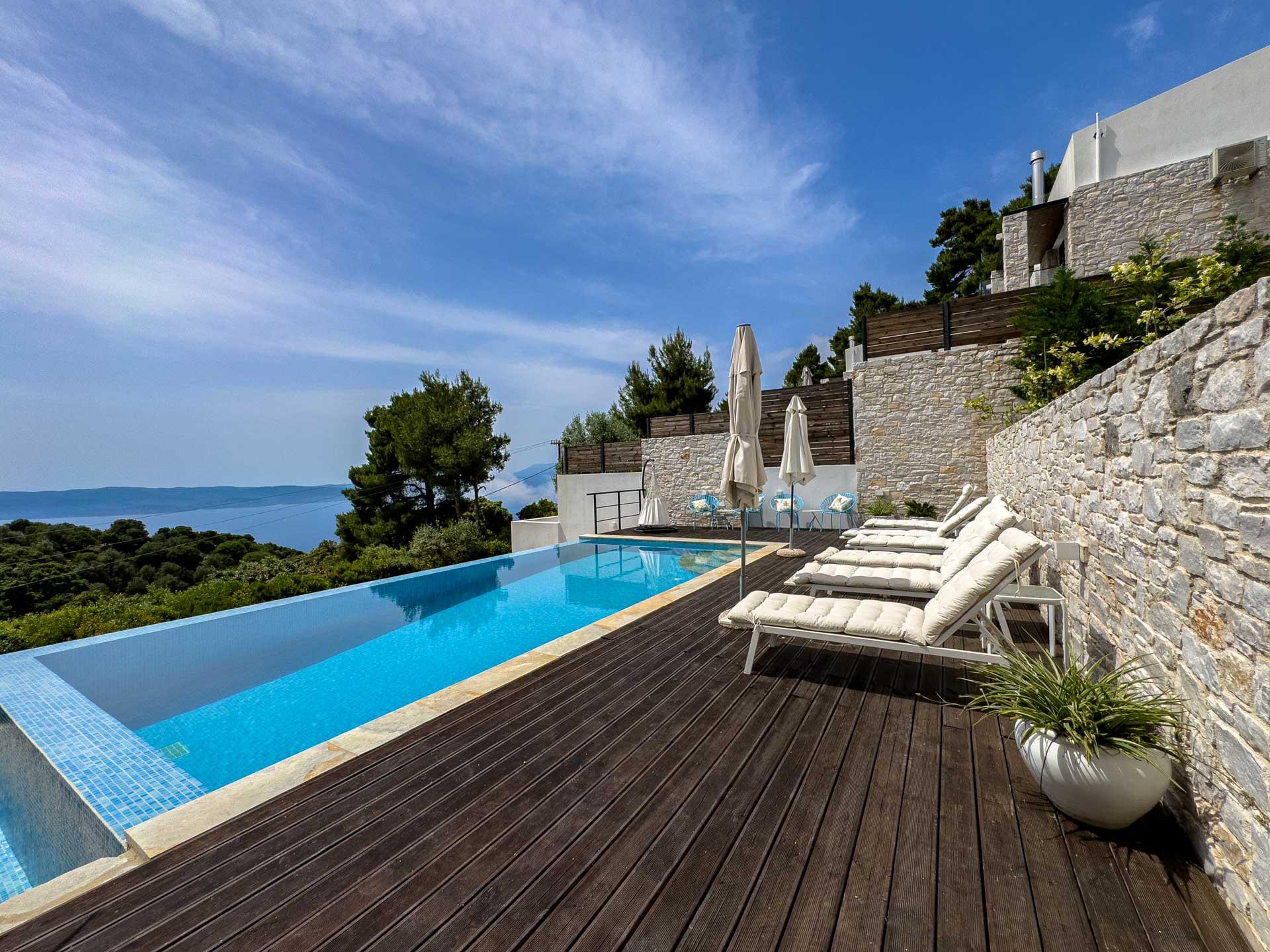
At Damari Luxury Villas, our two villas sit in the Kechria area, roughly 2.7 km from Lalaria - close enough that your host Tolis can arrange a boat trip booking or a private water-taxi transfer as part of your stay. Villa Moondancer sits at the highest point of the retreat with panoramic Aegean views, while Villa Whispering Pines offers complete privacy among the pine forest. Explore both villas or contact us to plan your trip.
Frequently asked questions
Can you walk to Lalaria Beach?
No. Lalaria sits at the base of near-vertical limestone cliffs on Skiathos's north coast, with no path or route down from above. The only access is by sea - via organised excursion boat, water taxi or private hire from Skiathos Old Port. There has never been land access to the beach.
How long does the boat trip to Lalaria take from Skiathos Town?
The journey from the old port takes approximately 30 to 40 minutes on an organised excursion that stops at the sea caves and Kastro en route. A direct water taxi reaches Lalaria in roughly 20 to 25 minutes. A half-day excursion including stops is typically 4 to 5 hours in total.
Are there sunbeds or tavernas at Lalaria?
No. Lalaria has zero organised facilities - no sunbeds, umbrellas, taverna, kiosk or toilets. The beach has always been undeveloped, with no road access and no flat land behind the pebbles. Bring water, food and sun protection before boarding the boat.
Is there shade at Lalaria Beach?
The limestone cliffs cast shade on the western end of the beach in the morning, roughly before 10:00–11:00 depending on season. After that the beach is fully exposed to direct sun until late afternoon. There are no trees or umbrellas, so a wide-brimmed hat and high-SPF sun protection are necessary.
What is the Tripia Petra arch and can you swim through it?
Tripia Petra ('pierced rock') is a natural arch formed by wave erosion at the eastern end of Lalaria. You can swim through it - the opening is wide enough for an adult and deep enough through summer. Local legend says swimming through it twice restores your youth, and it's the most-photographed feature of the beach.
When do organised boat trips to Lalaria start and finish?
Excursion boats typically depart from Skiathos Old Port in the morning (around 9:30–10:00) and return by 14:00–15:00, or depart early afternoon (around 14:00–15:00) and return by 19:00–19:30. Schedules vary by operator and can be disrupted by strong northerly winds, so arriving at the port by 09:00 in high season gives the best choice.